
Before I get to the Deck Library posts, I'd like to talk about a couple of things that happened this month. First, the milestone: this blog is now 2 years old. Two years! I hope that you're still enjoying it as much as ever. Finding content has never been a challenge; rather, it's time that has worked against me.
The heartbreak is that yesterday my Grandmother passed away. She had a stroke last week, but even before that she's had brain tumors, some successful removed, some not. I have found it hard to focus on other things, including this blog, because my Grandmother was like a Mom to me, and I lived with her for a few years growing up. When things like this happen, it provides a moment of clarity - that in the big picture, things like this blog are so unimportant compared to the health and well-being of a loved one. And yet it also reminds us that life is fleeting, so we should do the things we love while we have the chance. Since this blog is one of my passions, I'm dedicated more than ever to make it great.
Cheers, and live life with no regrets.
-Jackalwere
Friday, April 23, 2010

Tuesday, April 20, 2010
Creating a Deck Library for Guardians
Something I’ve been thinking about for some time is a deck library. This is essentially a place where you can find various decks that are out in the public domain in places like the Yahoo! Guardians Group message board, on CJ’s & Phil’s sites, and the Guardians Guide to the Mid Realms. The deck library contains all the decks in one central location for easy reference. I wasn’t sure how to go about this at first – maybe a downloadable file or a deck wiki…ultimately I decided on a shared Googledoc that you can access through a link on the sidebar.
In addition, each deck will be posted here as a blog entry, with some commentary by me. And I will also contribute some decks, of not just the authorized game but also some Seven Seas and some Champion’s Odyssey decks.
Now I just need a catchy name, such as the Library of the Necropolis or the Grand Avatar’s Compendium, or maybe the Vierkun Battle Archive. Any suggestions on the name?
In addition, each deck will be posted here as a blog entry, with some commentary by me. And I will also contribute some decks, of not just the authorized game but also some Seven Seas and some Champion’s Odyssey decks.
Now I just need a catchy name, such as the Library of the Necropolis or the Grand Avatar’s Compendium, or maybe the Vierkun Battle Archive. Any suggestions on the name?
Monday, April 12, 2010
One A few more card tweaks
I thought I might be done with card revisions, but as I was looking through them today I realized how dissatisfied I was with Magic Item Meltdown. This is a card, like some others, which I have changed numerous times, always trying to make the artwork and text fit, but I couldn't really blend them.
After a bit of inspiration and a name change, Magic Item Meltdown is now Forge Weapon. It allows you to use that Amulet of Flying or Altar of Takuli as a weapon in one combat matchup, similar to how a range attack is used, but when doing so it is discarded after combat. The discarding takes place immediately after combat but before healing or retreating, so you would discard the Altar without being able to use it to heal. It doesn't count towards determining who wins the space, and you do not *have* to use a Magic Item as a weapon, only that you *may* if you so desire. Magic Items not used as weapons are not discarded.

EDIT: I have also never really been happy with Witch Queen's Curse and Pawn of the Vierkuns. These have now been changed as well. Enjoy!


After a bit of inspiration and a name change, Magic Item Meltdown is now Forge Weapon. It allows you to use that Amulet of Flying or Altar of Takuli as a weapon in one combat matchup, similar to how a range attack is used, but when doing so it is discarded after combat. The discarding takes place immediately after combat but before healing or retreating, so you would discard the Altar without being able to use it to heal. It doesn't count towards determining who wins the space, and you do not *have* to use a Magic Item as a weapon, only that you *may* if you so desire. Magic Items not used as weapons are not discarded.

EDIT: I have also never really been happy with Witch Queen's Curse and Pawn of the Vierkuns. These have now been changed as well. Enjoy!


Friday, March 26, 2010
Last-minute card revision
I forgot I wanted to change the text for Caravan Route. This card has gone through more changes than any other card, first as an Event to Terrain, and now in the body of the text:

I chose the text based on the artwork, but I was never happy with it. I dropped the Spires & Jungle aspects, and removed the bonus for bribable creatures. I then added spending a Power Stone to look for a Shield if you bribed a creature this turn. The main reason is in going back through the message boards, it seemed like many people thought bribery was useless, while I feel it is an important part of the game. Therefore I created a system that gives you a small added advantage for using bribery...you can get a free Shield onto a Stronghold for only 1 Stone.

I chose the text based on the artwork, but I was never happy with it. I dropped the Spires & Jungle aspects, and removed the bonus for bribable creatures. I then added spending a Power Stone to look for a Shield if you bribed a creature this turn. The main reason is in going back through the message boards, it seemed like many people thought bribery was useless, while I feel it is an important part of the game. Therefore I created a system that gives you a small added advantage for using bribery...you can get a free Shield onto a Stronghold for only 1 Stone.
Saturday, March 20, 2010
Applications of Math in Guardians, Part 3: Dice Rolls
In our previous discussion of Math in Guardians, we looked at the subject of probability with regard to Planes of Entropy. This time we're going to expand that discussion to include all cards that use dice rolls in Guardians.
The Drifter's Nexus expansion introduced dice rolling into Guardians, largely due to the introduction of Entropy, also known as Chaos, and even sometimes called randomness. This was merely an experiment, it would seem, because the next expansion, Necropolis Park, doesn't have a single card that requires a dice roll. I revisited the concept with a few cards in my Champion's Odyssey expansion (including my Guardian), but to this day only 15 cards out of a total of 675 official cards use dice rolls. Those 15 cards are:
Demorgan the Inciter
Disc of Siin
Drifter's Nexus Stronghold Center
Drifter's Nexus Stronghold Left
Drifter's Nexus Stronghold Right
Garuda Kahn, First Disciple
Initiate of Entropy
Mendu Sada, the Havoc
Mighty Tiki God
Orella of the Mist
Planes of Entropy
Professor Heisenburg
Summon Entropy Storm
Vikia Tso'Shan'Lu
Xaz, Thief of Twilight
In a moment we'll take a closer look at these cards and how they are affected by probability. First, let's dive into some math that I mentioned in the last installment: Distribution and approaching the mean.
DISTRIBUTION & APPROACHING THE MEAN
Remember that I stated that averages, when used for probability, do indicate that we will flip an equal number of heads and tails over time. This is called a normal distribution. This also applies to dice rolls. To start, let's define what Mean is:
Arithmetic Mean is simply the sum of a group divided by the number of samples in the group. For instance, if you rolled a D6 6 times, getting a unique result each time, you would have results of 1, 2, 3, 4, 5, 6. Add those numbers together (21) and divide by the number of times you rolled (6). You get an average of 3.5. This 3.5 is our mean, an averaging out of unique rolls in our range.
Normally you don't want to use mean to calculate averages, because very high or low numbers can skew the data. If I live in the same town as Bill Gates, my income level & property values would be below the mean, because the income & property value of Bill Gates raises the mean greatly, so median is used instead (median income, median property value). But for rolling dice using mean is perfectly acceptable. There is a fixed range, 1 through 6, with an equal chance to roll any number.
As we continue to roll dice, our results will shift around but will eventually approach the mean.
To provide an example, I rolled a d6 100 times. These are the number of times I rolled each number:
1 = 13, total value = 13 (1 x 13)
2 = 18, total value = 36 (2 x 18)
3 = 20, total value = 60 (3 x 20)
4 = 16, total value = 64 (4 x 16)
5 = 23, total value = 115 (5 x 23)
6 = 10, total value = 60 (6 x 10)
Adding up the total value results in 348. Dividing 348 by 100 gives a mean of 3.48, which rounded off is 3.5, the same as what we established above.
Ok, you're saying, how is this useful? Think of it this way: for every 1 you roll, you'll roll a 6 (1 + 6 = 7, and 7/2 = 3.5). For every 2 you roll, you'll roll a 5 (2 + 5 = 7, and 7/2 = 3.5). For every 3 you roll, you'll roll a 4 (3 + 4 = 7, and 7/2 = 3.5). While that doesn't translate out to my 100 rolls exactly, it's pretty close. For example, I rolled 13 1's and 10 6's, only a difference of 3 per 100 rolls. Put into perspective for cards with a D6 roll, most have poor results with a low roll and optimal results with a high roll. Therefore, even if you roll high and get good results, approaching the mean indicates that you will eventually get corresponding low rolls that will hamper your strategies.
RUNS
Runs are results that consistent and concurrent, such as flipping 5 heads in a row. In my 100 D6 rolls, I never rolled more than 2 of the same number in a row. Looking at a grouping of numbers, such as rolling a 5 or a 6, I had one run of 6-5-5. Conversely, I had a runs of 1-2-1-2-2 and 1-1-2-1. Runs (which you might also call hot or cold streaks) make it seem like you are beating the averages, but as you can see from my totals, despite the runs you eventually end up approaching the mean.
Now, let's look at approaching the mean, combined with a revisiting of our mutually exclusive union, as they apply to the cards with dice rolls.
DRIFTER'S NEXUS STRONGHOLD
The Drifter's Nexus stronghold provides a 1D6+1 Vitality bonus. Here's what the other strongholds supply for bonuses (regardless of their other abilities):
Carreg Amroth = +5
Freebooter = +6 center, +4 left & right
Khnumian = +3
Necropolis Park = +3
Sabu Amantek = +4 center, +3 left & right
Drifter's Nexus has a range of +2 to +7. This means it can give you the best defense bonus, but it can also provide the worst. Without a special ability, the only reason to choose Drifter's Nexus is to gain the best defense bonus (at least equal to Carreg Amroth), +5, +6 or +7, which requires a roll of 4, 5 or 6. Our union probability tells us that the chance of this happening is 50%. Conversely, you have a 50% chance of rolling a 1, 2 or 3. This makes the Drifter's Nexus an unreliable defensive Stronghold. Half the games you play would have a good bonus, and the other half would not provide a good bonus. And in the context of approaching the mean, for each time you gain that +7, you're eventually going to get hit with a +2. Thinking back to my run of 1-2-1-2-2, if these were Drifter's Nexus rolls, I would have had a string of games with +2, +3, +2, +3, and +3, during which I'd be tearing my hair out in disbelief at my horrible dice rolling.
DISC OF SIIN AND MIGHTY TIKI GOD
Disc of Siin prevents channeling against your first # of primary attackers based on a D6 roll: 1 = no effect, 2 = 1, 3 = 2, 4 = 2, 5 = 3, 6 = all. Given that most Shields have 4-5 creatures under them, you have a 67% chance of protecting only your first 2 creatures. By contrast, an Ancient Ogre shuts down all opponent channeling for the remainder of combat. Disk of Siin has a few advantages over Ancient Ogre, however. First, it doesn't take up any Vitality under your Shield, while an Ancient Ogre takes 13 Vitality. Second, the Disc starts working on your first primary attacker, while Ogre doesn't start working until put into play, leaving some creatures unprotected if Ogre is not your first attacker. Third, you roll before primary attacks begin; therefore if you have a creature you want to protect from channeling, you know which spot to play it in to protect it. With an 84% chance to protect at least one creature, all things considered Disc of Siin is not a bad card.
Mighty Tiki God allows you to add 1D6 of Vitality to a primary matchup creature for each bribery card discarded, giving you a range of +1 to +6 per bribery card. You are just as likely to get a +1 as you are a +6, but ultimately you will approach the mean (3.5). How does this compare with other cards that give you combat bonuses? Most bonuses come with strings attached, such as working in a specific terrain or against large creatures. In fact, I can't find any card that gives all your creatures an unconditional bonus, except maybe Grand Poobah Schnee. In the right conditions (say, against an Undead deck with no bribable creatures), tossing bribery cards makes Mighty Tiki God very useful.
PROFESSOR HEISENBURG AND SUMMON ENTROPY STORM
Professor Heisenburg is an amazing card when it works. However, for your range attacker to destroy the opponent, you have to roll a 5 or 6, which would only happen 1 out of every 3 rolls. That means that 66% of the time you use it, the Professor is a wasted card.
Summon Entropy Storm, like the Professor, is a wasted card because 66% of the time you destroy your own creature. The only saving grace of the card is the fact that small creatures get +1 to the roll. Therefore a Tookle deck may want to consider it, because this changes the mean from 3.5 to 4.5. That's huge, because now a roll of 4-6 (50% chance) is successful. When you have fairies taking down Devils, Knights, Ogres, Dragons, and other bigger creatures every other time you play Summon Entropy Storm, it seems like a no-brainer.
DISCIPLES OF ENTROPY
Initiate of Entropy gets 1D6 added to its vitality. It has a Base Vitality of 2 and a stacking penalty of 5. You must roll a 3 for the vitality to equal the stacking penalty, and 4-6 to exceed it. Not a bad deal, since you have a 66% chance of rolling 3 or higher. Add in Mu Kir' Agavati's ability to re-roll and Initiate looks pretty good, especially if you roll a 5 or 6 - that's a Vitality of 7-8 that only stacks as 5! Plus you can channel 2 more if needed.
Demorgan the Inciter is truly unique - its the only card in the game that uses 2D6. It has a Base Vitality of 6 with a stacking penalty of 11. We determined that the mean for 1D6 is 3.5; for 2D6, the mean is 7. Since this is what you will average over time, that means Demorgan will average a 13 Vitality and only stack as 11. Looking at it another way, there are 11 equal chances to roll 2 through 12. You have a 9% chance to roll any number, and you must roll a 5 to equal the stacking penalty. You have a 73% chance to roll 5 or better - this is outstanding! Rolling double sixes gives you 18 Vitality with only an 11 stacking penalty! And we haven't even considered Mu Kir' yet...let's say you roll a 5 on one die and a 2 on the other. You can use Mu Kir' to re-roll that 2, knowing you're guaranteed at minimum a Vitality bonus of 6. One of the best cards in the game, period.
Mendu Sada is the not the worst of cards, but his ability is almost useless. An AOE of 1 or 2 is lousy, and rolling a 6 has no effect. That means half the time his ability is worthless. Add to the fact that he stacks as 11, when you might already have Demorgan or Garuda Kahn stacking as an 11, and there's really no place for Mendu except maybe against Tookle decks.
Orella of the Mist is also somewhat useless, as she only has a 33% chance to destroy the creature she faces and is only a 4 Vitality stacking as 7. Remember that re-rolling the dice with Mu Kir' doesn't change that 33% chance, it only gives a you a second try at it. Combined with Dragon Standard Bearer 19, however, she becomes a killing machine for only 1 Power Stone...roll your D6 first, then change the border color to match the die roll and watch her take down a Watcher or Eternal Witch Lord easily. She can even receive channeling!
Vikia Tso'Shan'Lu and Xaz, Thief of Twilight are very similar. Their abilities trigger on a roll of 3 or better, which you have a 66% chance of doing. Vikia stacks better as a 4, but must beat her opponent to trigger the ability, making it much harder to use, although she can accept channeling. Xaz just has to be in play to trigger the ability, but does take up a little more room with a 6 Vitality.
Garuda Kahn is last but not least. This guy was built to kill Guardians, and pretty much everything else in the game. It's as close to a "broken" card as you will find. Garuda is a 9 that stacks as 11. You want to play other Initiates with him to make use of his ability. That means you probably already have a Mu Kir' in play to re-roll any dice, and possibly an Initiate. That's going to give Garuda a 2D6 bonus, same as Demorgan, but starting at 9 Vitality instead of 6. Save him as a secondary attacker and you can get up to 4D6 or 5D6, allowing him to crush anything, including Guardians. This guy's only weaknesses are Beer and any effect that removes your Disciples from play.
That concludes part 3. There may be a part 4 in the future, but for now I'm moving on to other projects. I hope you've gotten some useful information out of the series.
p.s. I'll put some card scans into this post soon...
The Drifter's Nexus expansion introduced dice rolling into Guardians, largely due to the introduction of Entropy, also known as Chaos, and even sometimes called randomness. This was merely an experiment, it would seem, because the next expansion, Necropolis Park, doesn't have a single card that requires a dice roll. I revisited the concept with a few cards in my Champion's Odyssey expansion (including my Guardian), but to this day only 15 cards out of a total of 675 official cards use dice rolls. Those 15 cards are:
Demorgan the Inciter
Disc of Siin
Drifter's Nexus Stronghold Center
Drifter's Nexus Stronghold Left
Drifter's Nexus Stronghold Right
Garuda Kahn, First Disciple
Initiate of Entropy
Mendu Sada, the Havoc
Mighty Tiki God
Orella of the Mist
Planes of Entropy
Professor Heisenburg
Summon Entropy Storm
Vikia Tso'Shan'Lu
Xaz, Thief of Twilight
In a moment we'll take a closer look at these cards and how they are affected by probability. First, let's dive into some math that I mentioned in the last installment: Distribution and approaching the mean.
DISTRIBUTION & APPROACHING THE MEAN
Remember that I stated that averages, when used for probability, do indicate that we will flip an equal number of heads and tails over time. This is called a normal distribution. This also applies to dice rolls. To start, let's define what Mean is:
Arithmetic Mean is simply the sum of a group divided by the number of samples in the group. For instance, if you rolled a D6 6 times, getting a unique result each time, you would have results of 1, 2, 3, 4, 5, 6. Add those numbers together (21) and divide by the number of times you rolled (6). You get an average of 3.5. This 3.5 is our mean, an averaging out of unique rolls in our range.
Normally you don't want to use mean to calculate averages, because very high or low numbers can skew the data. If I live in the same town as Bill Gates, my income level & property values would be below the mean, because the income & property value of Bill Gates raises the mean greatly, so median is used instead (median income, median property value). But for rolling dice using mean is perfectly acceptable. There is a fixed range, 1 through 6, with an equal chance to roll any number.
As we continue to roll dice, our results will shift around but will eventually approach the mean.
To provide an example, I rolled a d6 100 times. These are the number of times I rolled each number:
1 = 13, total value = 13 (1 x 13)
2 = 18, total value = 36 (2 x 18)
3 = 20, total value = 60 (3 x 20)
4 = 16, total value = 64 (4 x 16)
5 = 23, total value = 115 (5 x 23)
6 = 10, total value = 60 (6 x 10)
Adding up the total value results in 348. Dividing 348 by 100 gives a mean of 3.48, which rounded off is 3.5, the same as what we established above.
Ok, you're saying, how is this useful? Think of it this way: for every 1 you roll, you'll roll a 6 (1 + 6 = 7, and 7/2 = 3.5). For every 2 you roll, you'll roll a 5 (2 + 5 = 7, and 7/2 = 3.5). For every 3 you roll, you'll roll a 4 (3 + 4 = 7, and 7/2 = 3.5). While that doesn't translate out to my 100 rolls exactly, it's pretty close. For example, I rolled 13 1's and 10 6's, only a difference of 3 per 100 rolls. Put into perspective for cards with a D6 roll, most have poor results with a low roll and optimal results with a high roll. Therefore, even if you roll high and get good results, approaching the mean indicates that you will eventually get corresponding low rolls that will hamper your strategies.
RUNS
Runs are results that consistent and concurrent, such as flipping 5 heads in a row. In my 100 D6 rolls, I never rolled more than 2 of the same number in a row. Looking at a grouping of numbers, such as rolling a 5 or a 6, I had one run of 6-5-5. Conversely, I had a runs of 1-2-1-2-2 and 1-1-2-1. Runs (which you might also call hot or cold streaks) make it seem like you are beating the averages, but as you can see from my totals, despite the runs you eventually end up approaching the mean.
Now, let's look at approaching the mean, combined with a revisiting of our mutually exclusive union, as they apply to the cards with dice rolls.
DRIFTER'S NEXUS STRONGHOLD
The Drifter's Nexus stronghold provides a 1D6+1 Vitality bonus. Here's what the other strongholds supply for bonuses (regardless of their other abilities):
Carreg Amroth = +5
Freebooter = +6 center, +4 left & right
Khnumian = +3
Necropolis Park = +3
Sabu Amantek = +4 center, +3 left & right
Drifter's Nexus has a range of +2 to +7. This means it can give you the best defense bonus, but it can also provide the worst. Without a special ability, the only reason to choose Drifter's Nexus is to gain the best defense bonus (at least equal to Carreg Amroth), +5, +6 or +7, which requires a roll of 4, 5 or 6. Our union probability tells us that the chance of this happening is 50%. Conversely, you have a 50% chance of rolling a 1, 2 or 3. This makes the Drifter's Nexus an unreliable defensive Stronghold. Half the games you play would have a good bonus, and the other half would not provide a good bonus. And in the context of approaching the mean, for each time you gain that +7, you're eventually going to get hit with a +2. Thinking back to my run of 1-2-1-2-2, if these were Drifter's Nexus rolls, I would have had a string of games with +2, +3, +2, +3, and +3, during which I'd be tearing my hair out in disbelief at my horrible dice rolling.
DISC OF SIIN AND MIGHTY TIKI GOD
Disc of Siin prevents channeling against your first # of primary attackers based on a D6 roll: 1 = no effect, 2 = 1, 3 = 2, 4 = 2, 5 = 3, 6 = all. Given that most Shields have 4-5 creatures under them, you have a 67% chance of protecting only your first 2 creatures. By contrast, an Ancient Ogre shuts down all opponent channeling for the remainder of combat. Disk of Siin has a few advantages over Ancient Ogre, however. First, it doesn't take up any Vitality under your Shield, while an Ancient Ogre takes 13 Vitality. Second, the Disc starts working on your first primary attacker, while Ogre doesn't start working until put into play, leaving some creatures unprotected if Ogre is not your first attacker. Third, you roll before primary attacks begin; therefore if you have a creature you want to protect from channeling, you know which spot to play it in to protect it. With an 84% chance to protect at least one creature, all things considered Disc of Siin is not a bad card.
Mighty Tiki God allows you to add 1D6 of Vitality to a primary matchup creature for each bribery card discarded, giving you a range of +1 to +6 per bribery card. You are just as likely to get a +1 as you are a +6, but ultimately you will approach the mean (3.5). How does this compare with other cards that give you combat bonuses? Most bonuses come with strings attached, such as working in a specific terrain or against large creatures. In fact, I can't find any card that gives all your creatures an unconditional bonus, except maybe Grand Poobah Schnee. In the right conditions (say, against an Undead deck with no bribable creatures), tossing bribery cards makes Mighty Tiki God very useful.
PROFESSOR HEISENBURG AND SUMMON ENTROPY STORM
Professor Heisenburg is an amazing card when it works. However, for your range attacker to destroy the opponent, you have to roll a 5 or 6, which would only happen 1 out of every 3 rolls. That means that 66% of the time you use it, the Professor is a wasted card.
Summon Entropy Storm, like the Professor, is a wasted card because 66% of the time you destroy your own creature. The only saving grace of the card is the fact that small creatures get +1 to the roll. Therefore a Tookle deck may want to consider it, because this changes the mean from 3.5 to 4.5. That's huge, because now a roll of 4-6 (50% chance) is successful. When you have fairies taking down Devils, Knights, Ogres, Dragons, and other bigger creatures every other time you play Summon Entropy Storm, it seems like a no-brainer.
DISCIPLES OF ENTROPY
Initiate of Entropy gets 1D6 added to its vitality. It has a Base Vitality of 2 and a stacking penalty of 5. You must roll a 3 for the vitality to equal the stacking penalty, and 4-6 to exceed it. Not a bad deal, since you have a 66% chance of rolling 3 or higher. Add in Mu Kir' Agavati's ability to re-roll and Initiate looks pretty good, especially if you roll a 5 or 6 - that's a Vitality of 7-8 that only stacks as 5! Plus you can channel 2 more if needed.
Demorgan the Inciter is truly unique - its the only card in the game that uses 2D6. It has a Base Vitality of 6 with a stacking penalty of 11. We determined that the mean for 1D6 is 3.5; for 2D6, the mean is 7. Since this is what you will average over time, that means Demorgan will average a 13 Vitality and only stack as 11. Looking at it another way, there are 11 equal chances to roll 2 through 12. You have a 9% chance to roll any number, and you must roll a 5 to equal the stacking penalty. You have a 73% chance to roll 5 or better - this is outstanding! Rolling double sixes gives you 18 Vitality with only an 11 stacking penalty! And we haven't even considered Mu Kir' yet...let's say you roll a 5 on one die and a 2 on the other. You can use Mu Kir' to re-roll that 2, knowing you're guaranteed at minimum a Vitality bonus of 6. One of the best cards in the game, period.
Mendu Sada is the not the worst of cards, but his ability is almost useless. An AOE of 1 or 2 is lousy, and rolling a 6 has no effect. That means half the time his ability is worthless. Add to the fact that he stacks as 11, when you might already have Demorgan or Garuda Kahn stacking as an 11, and there's really no place for Mendu except maybe against Tookle decks.
Orella of the Mist is also somewhat useless, as she only has a 33% chance to destroy the creature she faces and is only a 4 Vitality stacking as 7. Remember that re-rolling the dice with Mu Kir' doesn't change that 33% chance, it only gives a you a second try at it. Combined with Dragon Standard Bearer 19, however, she becomes a killing machine for only 1 Power Stone...roll your D6 first, then change the border color to match the die roll and watch her take down a Watcher or Eternal Witch Lord easily. She can even receive channeling!
Vikia Tso'Shan'Lu and Xaz, Thief of Twilight are very similar. Their abilities trigger on a roll of 3 or better, which you have a 66% chance of doing. Vikia stacks better as a 4, but must beat her opponent to trigger the ability, making it much harder to use, although she can accept channeling. Xaz just has to be in play to trigger the ability, but does take up a little more room with a 6 Vitality.
Garuda Kahn is last but not least. This guy was built to kill Guardians, and pretty much everything else in the game. It's as close to a "broken" card as you will find. Garuda is a 9 that stacks as 11. You want to play other Initiates with him to make use of his ability. That means you probably already have a Mu Kir' in play to re-roll any dice, and possibly an Initiate. That's going to give Garuda a 2D6 bonus, same as Demorgan, but starting at 9 Vitality instead of 6. Save him as a secondary attacker and you can get up to 4D6 or 5D6, allowing him to crush anything, including Guardians. This guy's only weaknesses are Beer and any effect that removes your Disciples from play.
That concludes part 3. There may be a part 4 in the future, but for now I'm moving on to other projects. I hope you've gotten some useful information out of the series.
p.s. I'll put some card scans into this post soon...
Thursday, March 18, 2010
Last of the card revisions
Here are the last few card revisions...
Deceiver becomes a Mortal Guy:

Blood Charge becomes more closely tied to movement vs. non-movement:

Scouring the Mid Realms gets a standard version (was Solo Adventures only):

I don't see doing anymore revision for some time. I'm pretty happy with the Champion's Odyssey set now. I will still be releasing a set of 10 chase cards, which I'll post details of soon.
EDIT: Sorry, forgot to add Circle of Protection. New artwork - I felt the old artwork was too realistic and not "cartoonish" enough. Also, it now cancels the AOE BEFORE it happens, but costs 3 cards instead of 2:

Deceiver becomes a Mortal Guy:

Blood Charge becomes more closely tied to movement vs. non-movement:

Scouring the Mid Realms gets a standard version (was Solo Adventures only):

I don't see doing anymore revision for some time. I'm pretty happy with the Champion's Odyssey set now. I will still be releasing a set of 10 chase cards, which I'll post details of soon.
EDIT: Sorry, forgot to add Circle of Protection. New artwork - I felt the old artwork was too realistic and not "cartoonish" enough. Also, it now cancels the AOE BEFORE it happens, but costs 3 cards instead of 2:

Thursday, March 11, 2010
A flurry of card revisions
Here we go, starting with Doom and Tomes of Transference:


Next we have an Upgrade and a Downgrade:


Next up is a Spell:

Finally, the creatures:


Note that 3 of the creatures have name changes...Orlan D'bloom is now Orlan Dubloon; Belial is now Orcus, Prince of Devils; and Archangel Sophia is now Seraph.
I have 1 creature and 2 events remaining and then I'm done. I will also need to go back and change the original card preview post for each card that has been revised.


Next we have an Upgrade and a Downgrade:


Next up is a Spell:

Finally, the creatures:


Note that 3 of the creatures have name changes...Orlan D'bloom is now Orlan Dubloon; Belial is now Orcus, Prince of Devils; and Archangel Sophia is now Seraph.
I have 1 creature and 2 events remaining and then I'm done. I will also need to go back and change the original card preview post for each card that has been revised.
Tuesday, March 9, 2010
Power cards
So on my birthday Sunday, I decided to surf around Phil's site for awhile, looking for more information for the next projects I'm working on. I re-read the Luke interview, and this quote caught my eye (paraphrased):
"Anyone can make one-shot power cards. We deliberately avoided that in Guardians - we didn't want to restrict any cards."
Wow. Here's the co-creator of Guardians talking about his vision about how the cards should be designed. And here's myself, designing one-shot power cards in Champion's Odyssey (like Doom & Tomes of Transference).
Now, to be fair, some of these cards were designed to take advantage of Balor's ability, rather than restricting them for having the potential to be abusive. However, I much prefer to restrict a card, instead of having to errata cards because of an environment with no restrictions (Champs, anyone?).
Add to that the challenge of creating new cards. There are 675 cards in Guardians. Seven Seas adds almost 200 cards. That's 875 cards. Now I show up and try to design another 100. And here's the thing about those 100 - you want to make them compelling. You want people to use them. You don't want them to say, "that card stinks" or "I would never use that card". Guardians has many different game mechanics, but you can only make so many cards before they start sounding like other cards.
Adding one-shot power cards keeps things fresh, keeps things different. I've kept them to a minimum, and they aren't too powerful. And though they place restrictions on the cards that Luke never intended, I think at some point the designers would have to go down that road to keep the game from stagnating. Still, I'm considering changing the cards, to maintain the spirit of the original game...
UPDATE: After more consideration I've decided the two cards I listed above (Doom and Tomes of Transference) are the only two that need to be changed because they contain the phrase "you may only have 1 copy of this card in your deck." It seems to me that this is the restriction to which Luke refers - in Guardians, there are no limits to how many copies of a card you can have in a deck. There are other restrictions in the game they seem to have no problem with (accessories that only allow only 1 copy in play, for instance). I'll be posting updates to these two cards soon - I have already fixed Tomes and am working on a solution to Doom.
"Anyone can make one-shot power cards. We deliberately avoided that in Guardians - we didn't want to restrict any cards."
Wow. Here's the co-creator of Guardians talking about his vision about how the cards should be designed. And here's myself, designing one-shot power cards in Champion's Odyssey (like Doom & Tomes of Transference).
Now, to be fair, some of these cards were designed to take advantage of Balor's ability, rather than restricting them for having the potential to be abusive. However, I much prefer to restrict a card, instead of having to errata cards because of an environment with no restrictions (Champs, anyone?).
Add to that the challenge of creating new cards. There are 675 cards in Guardians. Seven Seas adds almost 200 cards. That's 875 cards. Now I show up and try to design another 100. And here's the thing about those 100 - you want to make them compelling. You want people to use them. You don't want them to say, "that card stinks" or "I would never use that card". Guardians has many different game mechanics, but you can only make so many cards before they start sounding like other cards.
Adding one-shot power cards keeps things fresh, keeps things different. I've kept them to a minimum, and they aren't too powerful. And though they place restrictions on the cards that Luke never intended, I think at some point the designers would have to go down that road to keep the game from stagnating. Still, I'm considering changing the cards, to maintain the spirit of the original game...
UPDATE: After more consideration I've decided the two cards I listed above (Doom and Tomes of Transference) are the only two that need to be changed because they contain the phrase "you may only have 1 copy of this card in your deck." It seems to me that this is the restriction to which Luke refers - in Guardians, there are no limits to how many copies of a card you can have in a deck. There are other restrictions in the game they seem to have no problem with (accessories that only allow only 1 copy in play, for instance). I'll be posting updates to these two cards soon - I have already fixed Tomes and am working on a solution to Doom.
Saturday, March 6, 2010
New content coming soon
If you've heard nothing but Whispering Spirits from this blog lately, it's because I've been scouring the old rec.games and Yahoo! message boards from some information. Here's what I'm working on (not necessarily in this order):
1. Finishing card revisions for Champion's Odyssey.
2. Releasing a set of 10 Chase cards for Champion's Odyssey. These are brand new "promo" cards for Champion's Odyssey that only I will possess, initially. I'll ask a series of 10 riddles about Guardians. When someone answers a riddle correctly, one card will be revealed. I'll have more details on this soon.
3. Applications of Math in Guardians, Part 3.
4. Solo Adventures strategy, Part 2.
5. Creation of a "Deck Library." This will most likely be a shared Google doc, listing a collection of Guardians decks from the message boards, Phil's site, and CJ's site, plus some of my own. Call it a central location to find Guardians decks on the web. It's also one of the reasons I was scouring through the old message boards.
6. An unoffical FAQ & Glossary update to incorporate rules questions and terminology that have appeared on the message boards over the years. This is the other reason I have been looking through the message boards.
7. Discussion of Drifter's Nexus & Necropolis Park cards. May include creation of a visual database.
8. Hosting CJ's .sig cards, if he is willing.
As you can see, I've got a lot on my plate. There haven't been a lot of comments lately here or on the Yahoo! message board, and CJ hasn't updated his blog in some time. But if I have to single-handedly carry the torch to keep this fine game going, I'll do what I can.
Cheers!
1. Finishing card revisions for Champion's Odyssey.
2. Releasing a set of 10 Chase cards for Champion's Odyssey. These are brand new "promo" cards for Champion's Odyssey that only I will possess, initially. I'll ask a series of 10 riddles about Guardians. When someone answers a riddle correctly, one card will be revealed. I'll have more details on this soon.
3. Applications of Math in Guardians, Part 3.
4. Solo Adventures strategy, Part 2.
5. Creation of a "Deck Library." This will most likely be a shared Google doc, listing a collection of Guardians decks from the message boards, Phil's site, and CJ's site, plus some of my own. Call it a central location to find Guardians decks on the web. It's also one of the reasons I was scouring through the old message boards.
6. An unoffical FAQ & Glossary update to incorporate rules questions and terminology that have appeared on the message boards over the years. This is the other reason I have been looking through the message boards.
7. Discussion of Drifter's Nexus & Necropolis Park cards. May include creation of a visual database.
8. Hosting CJ's .sig cards, if he is willing.
As you can see, I've got a lot on my plate. There haven't been a lot of comments lately here or on the Yahoo! message board, and CJ hasn't updated his blog in some time. But if I have to single-handedly carry the torch to keep this fine game going, I'll do what I can.
Cheers!
Monday, February 15, 2010
Champion's Odyssey Card Revisions: Events
Let's start with 3 cards that were "Solo Adventures Only" and now have a regular version, Dragon's Wrath, Happy Hour, and Slave Auction:


Next is Witch Queen's Curse:

This was originally created back when I didn't understand how Events worked. It has now been corrected.
Next revisions: Creatures...


Next is Witch Queen's Curse:

This was originally created back when I didn't understand how Events worked. It has now been corrected.
Next revisions: Creatures...
Champion's Odyssey Card Revisions: Magic Items
Just a couple of revisions here...first is Tomes of Transference:
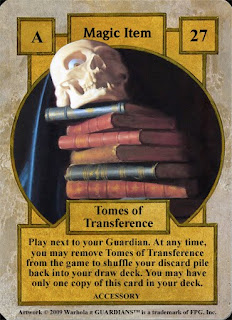
It went from a ho-hum function to a Wow! function. You won't run out of cards with this card handy. Unless it gets dispelled...
Next is Flametongue:

Removed the Desert reference (see previous posts).
That's it for Magic Items. Next up are Events...

It went from a ho-hum function to a Wow! function. You won't run out of cards with this card handy. Unless it gets dispelled...
Next is Flametongue:

Removed the Desert reference (see previous posts).
That's it for Magic Items. Next up are Events...
Saturday, February 13, 2010
Champion's Odyssey Card Revisions: Spells
Card revisions are coming fast & furious now.
First up is Doom. This was a solo only card, now a regular version exists:

A powerful card, but certainly limited - you can only have one in your deck, it can't be brought back (removed from game when played), and it can still be dispelled.
Next up is The Open Tomb. Modified to take advantage of Balor's ability:

Discard your upcard to basically draw an extra card.
Next revisions: Magic Items
First up is Doom. This was a solo only card, now a regular version exists:

A powerful card, but certainly limited - you can only have one in your deck, it can't be brought back (removed from game when played), and it can still be dispelled.
Next up is The Open Tomb. Modified to take advantage of Balor's ability:

Discard your upcard to basically draw an extra card.
Next revisions: Magic Items
Wednesday, February 10, 2010
Champion's Odyssey Card Revisions: Standard Bearers
No change to the Standard Bearer 15 card.
However, the Standard Bearer 19 card has been changed from "if you healed one creature this combat, gain one power stone" to "Discard a small creature under this Shield before combat begins. Your remaining creatures get a Vitality bonus equal to half the discarded creature's Vitality, rounded up."

The reason for the change is that I was struggling for ideas at the end of the set. This was a quick and dirty idea that basically takes the cost away from healing. Rather than do that, I decided to play into Balor's discard ability while making the benefit more aggressive. For instance, Sun Spirit gives all your other creatures +6 Vitality, but you're losing a 12 Vitality creature to do so. It's very situation-based.
Also, the Ship, Stygian Ferry, undergoes the following modification: "If you destroyed at least one creature this combat, gain one power stone" changes to "Opposing creatures lose all immunities for the duration of combat."

This was changed because there was already a standard bearer giving you a power stone for winning combat, so this seemed kind of redundant. I liked the idea of messing with immunities, which no other cards do.
There will be a few more changes coming...
However, the Standard Bearer 19 card has been changed from "if you healed one creature this combat, gain one power stone" to "Discard a small creature under this Shield before combat begins. Your remaining creatures get a Vitality bonus equal to half the discarded creature's Vitality, rounded up."

The reason for the change is that I was struggling for ideas at the end of the set. This was a quick and dirty idea that basically takes the cost away from healing. Rather than do that, I decided to play into Balor's discard ability while making the benefit more aggressive. For instance, Sun Spirit gives all your other creatures +6 Vitality, but you're losing a 12 Vitality creature to do so. It's very situation-based.
Also, the Ship, Stygian Ferry, undergoes the following modification: "If you destroyed at least one creature this combat, gain one power stone" changes to "Opposing creatures lose all immunities for the duration of combat."

This was changed because there was already a standard bearer giving you a power stone for winning combat, so this seemed kind of redundant. I liked the idea of messing with immunities, which no other cards do.
There will be a few more changes coming...
Tuesday, February 9, 2010
Champion's Odyssey Card Revision: Priestess of Kaukat
This card ended up being harder to design than it should have. Some folks here insisted it was too powerful. I knew it needed to be changed, but I couldn't decide what to do with it...
The other day I was looking through Brom artwork and I noticed the title of this art is "Ghoul Queen". That's when the pieces fell into place, as one of the more prominent creature types of this set was Ghouls.
Her name has been changed from Priestess of Kaukat to Ghoul Queen. Her ability (no longer a command card) now ties in nicely with Balor's "remove from game" ability, and she benefits from having other Ghouls around. I'm more comfortable with the design now, but please chime in with suggestions...

The other day I was looking through Brom artwork and I noticed the title of this art is "Ghoul Queen". That's when the pieces fell into place, as one of the more prominent creature types of this set was Ghouls.
Her name has been changed from Priestess of Kaukat to Ghoul Queen. Her ability (no longer a command card) now ties in nicely with Balor's "remove from game" ability, and she benefits from having other Ghouls around. I'm more comfortable with the design now, but please chime in with suggestions...

Sunday, January 24, 2010
Applications of Math in Guardians, Part 2: Deck Manipulation and Card Advantage
Well, the hiatus is officially over with this post.
If you need a refresher, you can find Part 1 here.
PREAMBLE
I've seen a game design philosophy for Guardians mentioned at least more than once, in the Guide to the Mid Realms and on the old message boards. And that philosophy is?
Guardians favors the aggressive player.
Seemingly based on the age-old mantra of "Fortune favors the bold", this philosophy is prevalent in the use of everything from flying decks and bribery to powerful channeling and movement strategy. Another component in which this is apparent is in Deck Manipulation and Card Advantage.
DECK MANIPULATION
First, let's define these terms. Deck Manipulation is being able to set up your deck so that you draw certain cards when you want to. The card text that enables this might read something like, "Search your deck for a Spell and put it in your Storage Hand." Or it might be, "Look at the top 6 cards of your deck and replace them in any order." Deck Manipulation can have 3 possible benefits:
1. You can immediately put into play a card that is useful in a specific situation; for example, maybe you need an Ancient Ogre to shut down your opponent's channel-heavy deck.
2. You can reduce your deck size. The benefit of reduced deck size is that as you pull specific cards out and the deck gets smaller, you increase the chance of drawing other types of cards in your deck later (think about hypergeometric distribution, which is a function of deck size).
3. Deck manipulation leads to card advantage.
CARD ADVANTAGE
Card Advantage is the ability to put more cards into play than your opponent by outdrawing your opponent, or forcing your opponent to lose cards in some way. A perfect example of this is the MDL & LDL modifiers, which are fitting for the "Guardians favors the aggressive player" mantra. If I have MDL and you have LDL, I am most likely drawing about 4 cards to your 2. Think of each card as an asset, or in other words, something I can put to use. Over the course of several turns, the more I draw and the less you draw, the more assets (creatures, shields, spells, terrain, etc.) I will be able to put into play. Thus I gain an advantage, as you could not hope to match the amount of assets I am able to bring to bear.
Probably the most famous examples of card advantage are 3 of the "Power Nine" cards from Magic the Gathering: Ancestral Recall, Time Walk, and Timetwister. These cards were considered some of the most powerful in the game, before they were restricted and then banned. Ancestral Recall allowed drawing three cards for a very cheap cost. Time Walk let a player take another turn, skipping the second player's turn and resulting in what could be considered a "double draw" for the first player. Timetwister allowed for all discarded cards to be shuffled back into the play deck, which gave an advantage to the player able to inflict instant damage. Why were they banned? The card advantage they provided was too great.
So how exactly does this relate to Guardians? Guardians has one restricted card, Champs, and yes it's restricted because of card advantage! Other than that one card, we must assume that there aren't any other cards that provide an unfair advantage. This means to gain true card advantage, a deck would have to use it as a theme (or a complimentary theme) rather than relying on 1 or 2 cards to provide it.
DRAW CLASSIFICATIONS
There are 4 classifications of cards that may be used to gain advantage through drawing or discarding:
1. Raw. Draw the top card(s) of your deck, or force opponent to discard top card(s) of deck. May require discard or Power Stone as cost to be paid.
2. Seek. Look through your deck (or your opponent's deck) for something and draw (or discard) it. May require discard or Power Stone as cost to be paid.
3. Conditional. Draw from your deck, or force opponent discards, *if* some specified event happens. May require discard or Power Stone as cost to be paid. You might not have control over the event.
4. Global. All players draw cards, or all players discard.
Below is a list of every card or game mechanic that fits the classifications above, with the classification listed next to it:
MDL: conditional
LDL: conditional
LUC: conditional
Ankh: raw
Argammond's Vision: raw
Assassin of Shadow: seek
Buster Scrimbo, conditional
Chant of the Osirans: conditional
Chickenhead McCracken: conditional
Eisnmir: conditional
Finn: conditional
Jonstollo the Seeker: conditional
K'Hutek: conditional
Planes of Entropy: raw
P'Tal: raw
Scarab of Bounty: conditional
Sebek, Queen of Magicians: raw
Shadow Strike: global
Shadow Warrior: conditional
Squibby: conditional
Tes Let: raw
The Hand of Chronos: global
Tookle: conditional
Vek-Nadra: conditional
What follows is an analysis of the cards above, whether they provide card advantage, and if so, how much.
CONDITIONAL DRAWS - UPCARDS

Buster Scrimbo, Chickenhead McCracken, Jonstollo the Seeker, and Squibby must be your upcard to gain an advantage. Let's say you have 4 Busters in a deck of 55. Using our hypergeometric distribution analysis, you are most likely to draw 1 Buster in your opening draw of 12. Of course, drawing him into your hand negates his ability (it can only be used when he is your upcard). So after you've drawn, you're ready to turn over your upcard, with 3 Busters left in a deck size of 43. Using our analysis again, you only have a 7% chance of drawing Buster as your upcard. Assuming you don't draw Buster as your upcard and you're drawing 4 cards on your next turn, since one of your cards drawn is your upcard, you're drawing 3 cards from your deck (which is now 42 because you pulled one card as your upcard last turn). Using our analysis once more, the most likely outcome (79%) is that you don't draw Buster. Now you turn over your upcard for this turn. To the analysis once more...you have a little over a 7% chance of drawing Buster, virtually unchanged from the previous turn.
There are two problems apparent here. One is that with such a low chance of drawing Buster (or Chickenhead or Jonstollo or Squibby) as your upcard, his special ability is largely useless. The second problem is that without his special ability, he becomes simply a 4 Vitality external with no combat ability. Compared with the abilities of other 4 Vitality creatures such as Amber Well, Cleric, or Haba Naba Kaba, Buster doesn't look so attractive. Even the repulsive Gorgal Skag, though it has no ability, is useful for the ability to fly.
CONDITIONAL DRAWS - GUARDIANS
Many of the Guardians in the game also have conditional draws. Eisnmir's draw is useless if the opponent plays very few magic items, and his LDL & MDL numbers are terrible. K'Hutek's draw only works well if you've been losing, a bad prospect. P'Tal's draw is raw instead of conditional, but it's also useless - you may be able to gain a card or two, but you're going to get kicked in the Power Stones for doing so.
Tes Let's ability, another raw, is useful but I'm not a big fan of throwing away cards to get cards - if you are throwing away cards, doesn't that mean that you could be using better ones?
This brings us to our most feasible Guardians for card advantage: Finn, Tookle, and Vek-Nadra.

At first Finn's ability seems extremely useful for a conditional draw - if you can keep at least two Swamps in play, you draw 2 extra cards, more than most other Guardians would get with just their MDL. But Finn only has a base draw of 2, so unless you can get 3 Swamps in play, you're only getting a one card (or no card) advantage over other Guardians, and it's even worse if you get the LDL, which is a -1 for Finn. Finn also locks you into one type of Terrain - Swamps - which limits your options on deck construction, and allows your opponent to stack up on Terrain bonus-busting cards.

Vek-Nedra's card advantage capability trumps Finn's on multiple levels. First, although Vek-Nadra also has a base draw of 2, he has no penalty from LDL, freeing you from worrying about disputed lands. Second, if you lose a battle but have at least one creature under your Shield, and you can retreat if required, Vek-Nadra keeps the card draw because the Shield is still alive. If you can keep 2-3 Shields in the disputed lands (which is entirely feasible), you'll gain 2-3 extra draws per turn. Remember that you can get that same draw with almost any other Guardian by winning MDL. Vek-Nadra simply removes the uncertainty of MDL & LDL from the equation.

However, when it comes to card advantage, Tookle has no equal. Small creatures & low upcard numbers go hand in hand. We just showed above how conditional draws for upcards are not an advantage. However, this changes with Tookle if all the creatures in the deck are small, because they represent a much higher percentage of the deck. Let's say that out of 55 cards, 30 are creatures. Using our hypergeometric distribution, we would expect to draw (on average) 7-8 creatures in our opening hand (let's use 8). Now we turn over the upcard. Our distribution shows that with 22 creatures left in a deck of 43 cards, we have a 51% chance of pulling a small creature, which gives Tookle an extra card draw. That's much better than the 7% chance of pulling Buster Scrimbo in our example above.
Fun fact: note that when you draw 1 card in the hypergeometric model, you can calculate the same 51% chance by simply dividing 22 creatures / 43 cards.
Anyway, back to Tookle's draw: Not only do you have a 51% chance of drawing a small creature, you have an excellent chance of also winning LUC, for another extra draw. With Tookle's base draw of 3, that means you have a 51% chance of drawing 5 cards per turn, and you can bump that to 6 cards if you win MDL. You can even increase those numbers up to 6-7 cards per turn by adding a Scarab of Bounty by Tookle's side, giving you +1 to LUC. Of course, Tookle's going to need that extra draw with all those wimpy creatures under his Shields. You can see now, though, how Tookle is the exception to any claim that there is no card advantage in Guardians.
PLANES OF ENTROPY

Finally , a discussion about probability! I love to argue probability with people, because they really don't understand how it works. There are several aspects of probability, but we are only going to cover chance, predictive probability, joint probability, unions, and averages. To illustrate this point, let's look at a simple coin-flip example. Let's say I flip a coin 10 times. Since I have a 50-50 chance of getting heads or tails, I should flip 5 heads and 5 tails, right?
Wrong.
Averages, when used for probability, do indicate that we will flip an equal number of heads and tails over time. This is called a normal distribution. If we assign heads a value of 1 and tails a value of 2, we could flip 10 times, add up the results, and divide by 10 to get an average. As you repeat this experiment several times, you will average a value of 1.5, which represents 50% heads and 50% tails. This is called approaching the mean. It involves a lot of complicated equations that I don't want to get into. Needless to say, it has no effect on a single coin flip. Why? Because a single coin flip is always heads or tails, and is not affected by the flip before it. For instance, say I flip heads. Now I'm going to flip again. My chance of flipping heads again is still 50%, since the only possible outcomes are heads or tails.
However, you can ask "what is the probability of flipping 5 heads in a row, before I start flipping?" This is called joint probability. If the chance of flipping heads is 1/2, or .5, then the chance of flipping heads 5 times is:
.5 x .5 x .5 x .5 x .5, or 3.125%.
This is predictive possibility - what *could* happen before you start. But once you start flipping, the probability changes.
Let's say I flipped tails. My probability of flipping 5 heads in a row is 0%, because I already got tails. But what if my first flip was heads? My first flip of heads will not affect my second flip - I can only get heads or tails. But looking at my predictive possibility of 5 heads in a row, I've already flipped my first heads. Now I need to flip 4 more heads in a row. The chance of doing this is:
.5 x .5 x .5 x .5, or 6.25%.
Say I was successful and flipped a second heads. Now to get 3 heads in a row the chance is .5 x .5 x .5, or 12.5%. Always remember that the past flips have no effect on the chances of your next flips.
The same concept applies to dice, but with 6 possible outcomes instead of 2. The chances of rolling a 1 are the same chances to roll a 6: 1/6, or 16.7%. The chance of NOT rolling a 1 are 5/6, or 83.3%. However, if we want to roll 2 dice, the chance of rolling snake eyes is 1/6 x 1/6, or 1/36 (2.8%). This is because there are 36 possible outcomes in this joint probability.
I could be wrong, but I can only think of one card that has you roll 2 dice in Guardians, which is Demorgan the Inciter. What is more useful to our discussion is a grouping within a single die roll, such as the chance to roll a 1 or 2.
This is called a mutually exclusive union - you cannot roll both a 1 and 2, but you can roll a 1 or 2, and combine the chance of doing so. Where our joint probability multiplied possible outcomes, our union adds possible outcomes. So rolling a 1 or 2 would be 1/6 + 1/6, equaling 2/6, or 33.3%. Now let's put that union probability to practical use.
Planes of Entropy allows you to ignore your draw for the turn and draw 1D6 cards instead. You would only want to do this when it was beneficial to you, unless you are a major risk taker. How do we determine when it would be beneficial?
Except in unusual cases, the worst a Guardian can draw is 1 (Finn with LDL and no Swamps in play would be a 1). In this case you would want to play Planes of Entropy, because you can roll no lower than 1.
But what if your card draw is 2? We established above that rolling a 1 is a 16.7% chance, and rolling a union of 1 or 2 is a 33.3% chance. This means you have a 33.3% chance of drawing the same or worse, but a 66.7% chance of drawing better. Not bad odds at all.
When you get to a 3 card draw, it would seem like your chances get a little risky, right? You have a 33.3% chance of drawing worse by rolling a 1 or 2. You have a 50% of drawing better by rolling a 4, 5 or 6. Looking at it another way, you have a 66.7% chance of drawing the same (3, 4, 5, 6) or better, still great odds. Sometimes it's all in how you look at your chances, because you really only lose if you roll a 1 or 2. Now that you know how to calculate the odds, you can decide if it's worth the risk.
Does Planes of Entropy give you card advantage? Remember that rolling a 5 or a 6 three times in a row, which you would need to gain a significant card advantage, is 2/6 x 2/6 x 2/6, or a predictive possibility of something like 3.6%. That's like flipping 5 heads in a row. What Planes of Entropy might do, however, is keep you from being at a disadvantage, which is still a good thing.
OPPONENT DISCARDS
There is one last concept I'd like to cover for card advantage, and that's opponent discards. If we defined card advantage as the ability to put more assets into play than your opponent, forcing an opponent to discard (and thus lose assets) meets this criteria. There are only a few cards that have the ability to force your opponent to burn cards. Are they worth using?
The short answer is no. When you force an opponent to discard a card, they do lose that card as an asset. However, that card is replaced by drawing the next card in their deck. A true card advantage through discard (and I'm going to drop another Magic the Gathering reference here) is "decking" your opponent. Decking means to run your opponent out of cards. The best example of this is the Millstone deck in Magic the Gathering. The Millstone card forced your opponent to discard two cards every turn; if you could get four of them in play, you could force your opponent to discard 8(!) cards per turn and rapidly run them out of cards, ending the game. While running out of cards doesn't end the game in Guardians, your chance of winning becomes slim if you're forced to rely on the cards you have remaining on the table. With that said, let's take a look at cards that discard.

Argammond's Vision, Assassin of Shadow, Shadow Strike, The Hand of Chronos: these cards have some usefulness...for instance, if your opponent has a Dragon Wing Lord as his upcard (or in his deck for the Assassin's ability), you can make sure it never gets under his Shield by forcing it into the discard pile. However, by playing one of these cards, you are giving up a card that could have been used as an asset, to force the opponent to also give up a card. Shadow Strike and The Hand of Chronos are even worse because you're giving up 2 potential assets (your upcard and Shadow Strike), or even 3 (for Chronos you lose 2 Power Stones as well!) to get rid of 1 opposing card. I'm not saying Chronos is useless; when you have an opportunity to win the game without letting your opponent get more cards or unturn Shields, it's extremely useful. What I am saying is that while all these cards are useful in specific ways, they do not lend themselves to card advantage.
Shadow Warrior, on the other hand, is exactly what we are looking for. It is an asset (a creature) that can also impact your opponent's deck. You *don't* have to attack your opponent's upcard, but think about this for a moment. In normal combat, you blindly put your attacker down, not knowing what your opponent is playing, and hoping for the best. In contrast, attacking an upcard is a thing of beauty: you can see the card you're attacking, and decide whether to attack or not. If you can beat it, you've just hurt your opponent twice...not only does he lose his upcard as a resource, but he will also draw one fewer card this turn. Remember that using our example above of 30 creatures & 55 cards, there's a 51% chance that the opponent's upcard will be a creature, great odds for the Shadow Warrior. The Warrior does have 2 areas of concern: if it can't beat the opposing upcard, it can't use it's ability; also, it takes up 30% of your Shield vitality (although that 9 Vitality is not bad for attacking with). So Shadow Warrior does provide a small amount of card advantage.

Chant of the Osirians is the closest card to a Millstone in the game. If you know you are going to be facing an Undead deck, pack at least 5 of these in your deck. Each time you play this, your opponent loses 5 cards, or 9% of a 55 card deck. Play it 5 times and they've discarded 45% of their deck, almost half! This card also works well with Sebek, Queen of Magicians - if you see your opponent has an Undead upcard and you've got an unused Power Lunch in your hand, put Sebek into play to discard the Power Lunch, go get the Chant of the Osirians, and force a 5 card discard. Nice! Though I don't like discarding cards to draw cards, that is worth it.
That wraps up Deck Manipulation and Card Advantage. I hope it was worth a read. Part 3 was going to cover cost/benefit of cards, but I think we'll expand our probability theory to include other cards that use dice rolls instead, and push cost/benefit ratios out to part 4.
If you need a refresher, you can find Part 1 here.
PREAMBLE
I've seen a game design philosophy for Guardians mentioned at least more than once, in the Guide to the Mid Realms and on the old message boards. And that philosophy is?
Guardians favors the aggressive player.
Seemingly based on the age-old mantra of "Fortune favors the bold", this philosophy is prevalent in the use of everything from flying decks and bribery to powerful channeling and movement strategy. Another component in which this is apparent is in Deck Manipulation and Card Advantage.
DECK MANIPULATION
First, let's define these terms. Deck Manipulation is being able to set up your deck so that you draw certain cards when you want to. The card text that enables this might read something like, "Search your deck for a Spell and put it in your Storage Hand." Or it might be, "Look at the top 6 cards of your deck and replace them in any order." Deck Manipulation can have 3 possible benefits:
1. You can immediately put into play a card that is useful in a specific situation; for example, maybe you need an Ancient Ogre to shut down your opponent's channel-heavy deck.
2. You can reduce your deck size. The benefit of reduced deck size is that as you pull specific cards out and the deck gets smaller, you increase the chance of drawing other types of cards in your deck later (think about hypergeometric distribution, which is a function of deck size).
3. Deck manipulation leads to card advantage.
CARD ADVANTAGE
Card Advantage is the ability to put more cards into play than your opponent by outdrawing your opponent, or forcing your opponent to lose cards in some way. A perfect example of this is the MDL & LDL modifiers, which are fitting for the "Guardians favors the aggressive player" mantra. If I have MDL and you have LDL, I am most likely drawing about 4 cards to your 2. Think of each card as an asset, or in other words, something I can put to use. Over the course of several turns, the more I draw and the less you draw, the more assets (creatures, shields, spells, terrain, etc.) I will be able to put into play. Thus I gain an advantage, as you could not hope to match the amount of assets I am able to bring to bear.
Probably the most famous examples of card advantage are 3 of the "Power Nine" cards from Magic the Gathering: Ancestral Recall, Time Walk, and Timetwister. These cards were considered some of the most powerful in the game, before they were restricted and then banned. Ancestral Recall allowed drawing three cards for a very cheap cost. Time Walk let a player take another turn, skipping the second player's turn and resulting in what could be considered a "double draw" for the first player. Timetwister allowed for all discarded cards to be shuffled back into the play deck, which gave an advantage to the player able to inflict instant damage. Why were they banned? The card advantage they provided was too great.
So how exactly does this relate to Guardians? Guardians has one restricted card, Champs, and yes it's restricted because of card advantage! Other than that one card, we must assume that there aren't any other cards that provide an unfair advantage. This means to gain true card advantage, a deck would have to use it as a theme (or a complimentary theme) rather than relying on 1 or 2 cards to provide it.
DRAW CLASSIFICATIONS
There are 4 classifications of cards that may be used to gain advantage through drawing or discarding:
1. Raw. Draw the top card(s) of your deck, or force opponent to discard top card(s) of deck. May require discard or Power Stone as cost to be paid.
2. Seek. Look through your deck (or your opponent's deck) for something and draw (or discard) it. May require discard or Power Stone as cost to be paid.
3. Conditional. Draw from your deck, or force opponent discards, *if* some specified event happens. May require discard or Power Stone as cost to be paid. You might not have control over the event.
4. Global. All players draw cards, or all players discard.
Below is a list of every card or game mechanic that fits the classifications above, with the classification listed next to it:
MDL: conditional
LDL: conditional
LUC: conditional
Ankh: raw
Argammond's Vision: raw
Assassin of Shadow: seek
Buster Scrimbo, conditional
Chant of the Osirans: conditional
Chickenhead McCracken: conditional
Eisnmir: conditional
Finn: conditional
Jonstollo the Seeker: conditional
K'Hutek: conditional
Planes of Entropy: raw
P'Tal: raw
Scarab of Bounty: conditional
Sebek, Queen of Magicians: raw
Shadow Strike: global
Shadow Warrior: conditional
Squibby: conditional
Tes Let: raw
The Hand of Chronos: global
Tookle: conditional
Vek-Nadra: conditional
What follows is an analysis of the cards above, whether they provide card advantage, and if so, how much.
CONDITIONAL DRAWS - UPCARDS

Buster Scrimbo, Chickenhead McCracken, Jonstollo the Seeker, and Squibby must be your upcard to gain an advantage. Let's say you have 4 Busters in a deck of 55. Using our hypergeometric distribution analysis, you are most likely to draw 1 Buster in your opening draw of 12. Of course, drawing him into your hand negates his ability (it can only be used when he is your upcard). So after you've drawn, you're ready to turn over your upcard, with 3 Busters left in a deck size of 43. Using our analysis again, you only have a 7% chance of drawing Buster as your upcard. Assuming you don't draw Buster as your upcard and you're drawing 4 cards on your next turn, since one of your cards drawn is your upcard, you're drawing 3 cards from your deck (which is now 42 because you pulled one card as your upcard last turn). Using our analysis once more, the most likely outcome (79%) is that you don't draw Buster. Now you turn over your upcard for this turn. To the analysis once more...you have a little over a 7% chance of drawing Buster, virtually unchanged from the previous turn.
There are two problems apparent here. One is that with such a low chance of drawing Buster (or Chickenhead or Jonstollo or Squibby) as your upcard, his special ability is largely useless. The second problem is that without his special ability, he becomes simply a 4 Vitality external with no combat ability. Compared with the abilities of other 4 Vitality creatures such as Amber Well, Cleric, or Haba Naba Kaba, Buster doesn't look so attractive. Even the repulsive Gorgal Skag, though it has no ability, is useful for the ability to fly.
CONDITIONAL DRAWS - GUARDIANS
Many of the Guardians in the game also have conditional draws. Eisnmir's draw is useless if the opponent plays very few magic items, and his LDL & MDL numbers are terrible. K'Hutek's draw only works well if you've been losing, a bad prospect. P'Tal's draw is raw instead of conditional, but it's also useless - you may be able to gain a card or two, but you're going to get kicked in the Power Stones for doing so.
Tes Let's ability, another raw, is useful but I'm not a big fan of throwing away cards to get cards - if you are throwing away cards, doesn't that mean that you could be using better ones?
This brings us to our most feasible Guardians for card advantage: Finn, Tookle, and Vek-Nadra.

At first Finn's ability seems extremely useful for a conditional draw - if you can keep at least two Swamps in play, you draw 2 extra cards, more than most other Guardians would get with just their MDL. But Finn only has a base draw of 2, so unless you can get 3 Swamps in play, you're only getting a one card (or no card) advantage over other Guardians, and it's even worse if you get the LDL, which is a -1 for Finn. Finn also locks you into one type of Terrain - Swamps - which limits your options on deck construction, and allows your opponent to stack up on Terrain bonus-busting cards.

Vek-Nedra's card advantage capability trumps Finn's on multiple levels. First, although Vek-Nadra also has a base draw of 2, he has no penalty from LDL, freeing you from worrying about disputed lands. Second, if you lose a battle but have at least one creature under your Shield, and you can retreat if required, Vek-Nadra keeps the card draw because the Shield is still alive. If you can keep 2-3 Shields in the disputed lands (which is entirely feasible), you'll gain 2-3 extra draws per turn. Remember that you can get that same draw with almost any other Guardian by winning MDL. Vek-Nadra simply removes the uncertainty of MDL & LDL from the equation.

However, when it comes to card advantage, Tookle has no equal. Small creatures & low upcard numbers go hand in hand. We just showed above how conditional draws for upcards are not an advantage. However, this changes with Tookle if all the creatures in the deck are small, because they represent a much higher percentage of the deck. Let's say that out of 55 cards, 30 are creatures. Using our hypergeometric distribution, we would expect to draw (on average) 7-8 creatures in our opening hand (let's use 8). Now we turn over the upcard. Our distribution shows that with 22 creatures left in a deck of 43 cards, we have a 51% chance of pulling a small creature, which gives Tookle an extra card draw. That's much better than the 7% chance of pulling Buster Scrimbo in our example above.
Fun fact: note that when you draw 1 card in the hypergeometric model, you can calculate the same 51% chance by simply dividing 22 creatures / 43 cards.
Anyway, back to Tookle's draw: Not only do you have a 51% chance of drawing a small creature, you have an excellent chance of also winning LUC, for another extra draw. With Tookle's base draw of 3, that means you have a 51% chance of drawing 5 cards per turn, and you can bump that to 6 cards if you win MDL. You can even increase those numbers up to 6-7 cards per turn by adding a Scarab of Bounty by Tookle's side, giving you +1 to LUC. Of course, Tookle's going to need that extra draw with all those wimpy creatures under his Shields. You can see now, though, how Tookle is the exception to any claim that there is no card advantage in Guardians.
PLANES OF ENTROPY

Finally , a discussion about probability! I love to argue probability with people, because they really don't understand how it works. There are several aspects of probability, but we are only going to cover chance, predictive probability, joint probability, unions, and averages. To illustrate this point, let's look at a simple coin-flip example. Let's say I flip a coin 10 times. Since I have a 50-50 chance of getting heads or tails, I should flip 5 heads and 5 tails, right?
Wrong.
Averages, when used for probability, do indicate that we will flip an equal number of heads and tails over time. This is called a normal distribution. If we assign heads a value of 1 and tails a value of 2, we could flip 10 times, add up the results, and divide by 10 to get an average. As you repeat this experiment several times, you will average a value of 1.5, which represents 50% heads and 50% tails. This is called approaching the mean. It involves a lot of complicated equations that I don't want to get into. Needless to say, it has no effect on a single coin flip. Why? Because a single coin flip is always heads or tails, and is not affected by the flip before it. For instance, say I flip heads. Now I'm going to flip again. My chance of flipping heads again is still 50%, since the only possible outcomes are heads or tails.
However, you can ask "what is the probability of flipping 5 heads in a row, before I start flipping?" This is called joint probability. If the chance of flipping heads is 1/2, or .5, then the chance of flipping heads 5 times is:
.5 x .5 x .5 x .5 x .5, or 3.125%.
This is predictive possibility - what *could* happen before you start. But once you start flipping, the probability changes.
Let's say I flipped tails. My probability of flipping 5 heads in a row is 0%, because I already got tails. But what if my first flip was heads? My first flip of heads will not affect my second flip - I can only get heads or tails. But looking at my predictive possibility of 5 heads in a row, I've already flipped my first heads. Now I need to flip 4 more heads in a row. The chance of doing this is:
.5 x .5 x .5 x .5, or 6.25%.
Say I was successful and flipped a second heads. Now to get 3 heads in a row the chance is .5 x .5 x .5, or 12.5%. Always remember that the past flips have no effect on the chances of your next flips.
The same concept applies to dice, but with 6 possible outcomes instead of 2. The chances of rolling a 1 are the same chances to roll a 6: 1/6, or 16.7%. The chance of NOT rolling a 1 are 5/6, or 83.3%. However, if we want to roll 2 dice, the chance of rolling snake eyes is 1/6 x 1/6, or 1/36 (2.8%). This is because there are 36 possible outcomes in this joint probability.
I could be wrong, but I can only think of one card that has you roll 2 dice in Guardians, which is Demorgan the Inciter. What is more useful to our discussion is a grouping within a single die roll, such as the chance to roll a 1 or 2.
This is called a mutually exclusive union - you cannot roll both a 1 and 2, but you can roll a 1 or 2, and combine the chance of doing so. Where our joint probability multiplied possible outcomes, our union adds possible outcomes. So rolling a 1 or 2 would be 1/6 + 1/6, equaling 2/6, or 33.3%. Now let's put that union probability to practical use.
Planes of Entropy allows you to ignore your draw for the turn and draw 1D6 cards instead. You would only want to do this when it was beneficial to you, unless you are a major risk taker. How do we determine when it would be beneficial?
Except in unusual cases, the worst a Guardian can draw is 1 (Finn with LDL and no Swamps in play would be a 1). In this case you would want to play Planes of Entropy, because you can roll no lower than 1.
But what if your card draw is 2? We established above that rolling a 1 is a 16.7% chance, and rolling a union of 1 or 2 is a 33.3% chance. This means you have a 33.3% chance of drawing the same or worse, but a 66.7% chance of drawing better. Not bad odds at all.
When you get to a 3 card draw, it would seem like your chances get a little risky, right? You have a 33.3% chance of drawing worse by rolling a 1 or 2. You have a 50% of drawing better by rolling a 4, 5 or 6. Looking at it another way, you have a 66.7% chance of drawing the same (3, 4, 5, 6) or better, still great odds. Sometimes it's all in how you look at your chances, because you really only lose if you roll a 1 or 2. Now that you know how to calculate the odds, you can decide if it's worth the risk.
Does Planes of Entropy give you card advantage? Remember that rolling a 5 or a 6 three times in a row, which you would need to gain a significant card advantage, is 2/6 x 2/6 x 2/6, or a predictive possibility of something like 3.6%. That's like flipping 5 heads in a row. What Planes of Entropy might do, however, is keep you from being at a disadvantage, which is still a good thing.
OPPONENT DISCARDS
There is one last concept I'd like to cover for card advantage, and that's opponent discards. If we defined card advantage as the ability to put more assets into play than your opponent, forcing an opponent to discard (and thus lose assets) meets this criteria. There are only a few cards that have the ability to force your opponent to burn cards. Are they worth using?
The short answer is no. When you force an opponent to discard a card, they do lose that card as an asset. However, that card is replaced by drawing the next card in their deck. A true card advantage through discard (and I'm going to drop another Magic the Gathering reference here) is "decking" your opponent. Decking means to run your opponent out of cards. The best example of this is the Millstone deck in Magic the Gathering. The Millstone card forced your opponent to discard two cards every turn; if you could get four of them in play, you could force your opponent to discard 8(!) cards per turn and rapidly run them out of cards, ending the game. While running out of cards doesn't end the game in Guardians, your chance of winning becomes slim if you're forced to rely on the cards you have remaining on the table. With that said, let's take a look at cards that discard.

Argammond's Vision, Assassin of Shadow, Shadow Strike, The Hand of Chronos: these cards have some usefulness...for instance, if your opponent has a Dragon Wing Lord as his upcard (or in his deck for the Assassin's ability), you can make sure it never gets under his Shield by forcing it into the discard pile. However, by playing one of these cards, you are giving up a card that could have been used as an asset, to force the opponent to also give up a card. Shadow Strike and The Hand of Chronos are even worse because you're giving up 2 potential assets (your upcard and Shadow Strike), or even 3 (for Chronos you lose 2 Power Stones as well!) to get rid of 1 opposing card. I'm not saying Chronos is useless; when you have an opportunity to win the game without letting your opponent get more cards or unturn Shields, it's extremely useful. What I am saying is that while all these cards are useful in specific ways, they do not lend themselves to card advantage.
Shadow Warrior, on the other hand, is exactly what we are looking for. It is an asset (a creature) that can also impact your opponent's deck. You *don't* have to attack your opponent's upcard, but think about this for a moment. In normal combat, you blindly put your attacker down, not knowing what your opponent is playing, and hoping for the best. In contrast, attacking an upcard is a thing of beauty: you can see the card you're attacking, and decide whether to attack or not. If you can beat it, you've just hurt your opponent twice...not only does he lose his upcard as a resource, but he will also draw one fewer card this turn. Remember that using our example above of 30 creatures & 55 cards, there's a 51% chance that the opponent's upcard will be a creature, great odds for the Shadow Warrior. The Warrior does have 2 areas of concern: if it can't beat the opposing upcard, it can't use it's ability; also, it takes up 30% of your Shield vitality (although that 9 Vitality is not bad for attacking with). So Shadow Warrior does provide a small amount of card advantage.

Chant of the Osirians is the closest card to a Millstone in the game. If you know you are going to be facing an Undead deck, pack at least 5 of these in your deck. Each time you play this, your opponent loses 5 cards, or 9% of a 55 card deck. Play it 5 times and they've discarded 45% of their deck, almost half! This card also works well with Sebek, Queen of Magicians - if you see your opponent has an Undead upcard and you've got an unused Power Lunch in your hand, put Sebek into play to discard the Power Lunch, go get the Chant of the Osirians, and force a 5 card discard. Nice! Though I don't like discarding cards to draw cards, that is worth it.
That wraps up Deck Manipulation and Card Advantage. I hope it was worth a read. Part 3 was going to cover cost/benefit of cards, but I think we'll expand our probability theory to include other cards that use dice rolls instead, and push cost/benefit ratios out to part 4.
Subscribe to:
Posts (Atom)

 Posts
Posts

